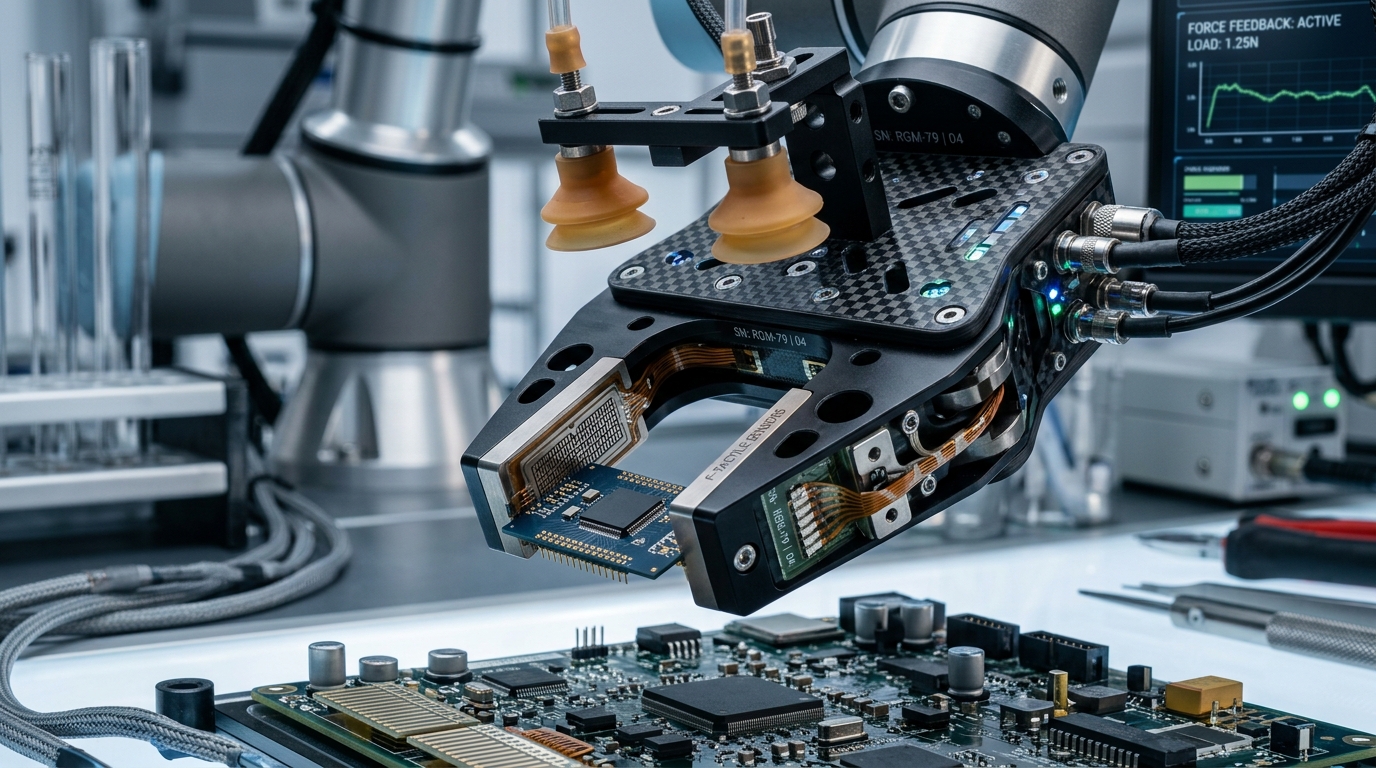
Core Engineering Takeaways
- •Form closure immobilizes an object geometrically without requiring active gripping force, whereas force closure relies strictly on contact normal forces and frictional shear.
- •Pneumatic grippers offer unbeatable power-to-weight density and cycle speed, but electric servogrippers provide closed-loop position, force regulation, and part-size verification.
- •Vacuum cup lifting calculations must account for dynamic accelerations ($a_z$ and lateral jerk), cup diameter, friction coefficients on wet/oily cardboard, and safe safety margins (typically 2.0x to 4.0x).
- •Modern vision-based tactile sensors (GelSight, DIGIT) reconstruct micro-scale contact geometry and 3D shear deformation fields in real-time using embedded cameras and elastomer membranes.
- •ROS 2 controls industrial grippers via standardized control_msgs/action/GripperCommand action interfaces, unifying stroke distance targets and max effort limits across diverse hardware vendors.
- Classical mechanics (Newtonian forces, friction coefficients, torque equilibrium)
- Basic pneumatics and compressed air concepts (pressure, bar, SCFM, flow rate)
- Familiarity with robot kinematics and tool center points (TCP)
1. End-Effector Taxonomy: Mechanical, Vacuum, Magnetic & Soft Tooling
The robot arm serves merely as a spatial positioning mechanism; the end-effector (Tool Center Point - TCP) is where physical work actually happens.
Selecting or engineering the correct end-effector determines whether an automated cell achieves 99.9% uptime or suffers frequent dropped parts, cycle stalls, and product damage.
Primary End-Effector Categories:
- 1Parallel-Jaw Grippers:
- The industrial workhorse. Features two opposing fingers driven along a linear axis.
- High structural rigidity, excellent repeatability (), and straightforward finger machining.
- Best for rigid parts with parallel exterior datum planes (machined metal blocks, molded enclosures).
- 2Multi-Finger Anthropomorphic & Underactuated Hands:
- Three to five fingers with multiple joints per digit.
- Underactuated designs use tendon cables and compliant springs driven by a single motor to automatically envelope irregular shapes.
- Ideal for unstructured service robotics, prosthetic research, and mixed-SKU warehouse picking.
- 3Vacuum & Suction Systems:
- Uses elastomeric suction bellows powered by venturi air ejectors or high-flow regenerative blowers.
- Single-sided contact eliminates the need to reach around part edges.
- The universal choice for sheet metal stamping, carton palletizing, glass glazing, and solar cell transport.
- 4Soft Fluidic & Fin-Ray Biomimetic Grippers:
- Molded silicone fingers that curl pneumatically (PneuNets) or flexible plastic fingers that conform via the Fin-Ray rib effect.
- Inherent compliance prevents crushing delicate fruits, bakery items, or thin laboratory glassware.
The total mass of the end-effector, pneumatic manifold, sensor puck, and quick-change mount subtracts directly from the cobot/robot arm rated payload. Never let the gripper consume more than 30–40% of the robot wrist capacity.
2. Grasp Mechanics: Form Closure, Force Closure & Friction Cones
To securely manipulate an object without dropping or reorienting it during trajectory accelerations, the gripper contacts must resist all external disturbance wrenches (forces and torques).
Form Closure vs. Force Closure
- Form Closure (Positive Locking): The geometry of the fingers physically prevents any object motion in all degrees of freedom, even if the contact friction coefficient . (Example: Enclosing a sphere inside custom-molded concave finger cavities).
- Force Closure: The grasp maintains equilibrium purely through normal contact forces and tangential friction forces within the Coulomb friction limit.
Friction Cone Constraint
For each point contact with friction, the contact force vector must lie inside a conical boundary defined by static friction coefficient :
If the tangential shear exceeds , instantaneous slip occurs, leading to dropped parts.
Minimum Normal Gripping Force Equation
For a 2.5 kg part, robot acceleration 15 m/s², 2 fingers with rubber pads (μ = 0.4), and safety factor 2.5: F_n = [2.5 × (9.81 + 15) × 2.5] / [2 × 0.4] = 193.8 N per finger.
3. Actuation Physics: Electric Servo vs Pneumatic vs Voice-Coil
Choosing the prime mover for a gripper determines its speed, precision, operational cost, and cleanroom compatibility:
1. Pneumatic Actuation (Double-Acting Cylinders)
- Strengths: Highest power-to-weight ratio. Compact mechanical footprint at the wrist. Immensely reliable over millions of cycles without thermal burnout.
- Limitations: Binary positioning (fully open or fully closed). Difficult to regulate force gently unless paired with expensive proportional electropneumatic regulators. Requires plant compressed air lines (6 bar / 90 psi).
2. Electric Stepper / Brushless DC Servogrippers
- Strengths: Continuous stroke positioning, velocity profiling, and current-based force regulation. Ability to inspect part dimensions on every grasp cycle (e.g., verifying whether a pin is within tolerance).
- Limitations: Heavier than pneumatic equivalents due to internal planetary gearboxes, encoders, and motor coils. Lower peak clamping force for equivalent outer envelope.
3. Voice Coil & Linear Direct-Drive Grippers
- Strengths: Zero cogging, zero backlash, ultra-fast 10 ms cycle times, and millinewton-level closed-loop force sensitivity. Ideal for semiconductor wire bonding and optical lens manipulation.
| Metric | Pneumatic Cylinder | Electric Brushless Servo | Voice Coil Linear |
|---|---|---|---|
| Position Control | Binary (Open/Close) | Micrometer Programmable | Sub-micron Continuous |
| Force Controllability | Poor (Air pressure regulated) | High (Motor torque feedback) | Exceptional (< 5 mN resolution) |
| Cycle Speed | Very Fast (20 - 50 ms) | Moderate (100 - 300 ms) | Ultra-Fast (< 15 ms) |
| Wrist Weight Ratio | Very Lightweight (< 300g) | Moderate (600g - 1.5kg) | Compact to Medium |
| Cost & Infrastructure | Low initial cost, needs compressor | Self-contained 24V DC bus | Premium niche electronics |
| Cleanroom Grade | Requires exhaust mufflers/piping | ISO Class 5 certified | ISO Class 1-3 compatible |
4. Vacuum Cup Sizing & Venturi Ejector Flow Dynamics
Vacuum lifting does not pull a workpiece; rather, atmospheric pressure pushes the workpiece against the cup while an ejector removes air molecules from the internal cavity.
The Physics of Vacuum Holding Force
The theoretical holding force perpendicular to the cup face is given by:
Where:
- is the internal effective suction cup diameter.
- is the vacuum differential pressure (typically to relative to atmospheric).
Venturi Ejector vs Mechanical Vacuum Blowers
- Venturi Air Ejectors (Compressed Air Driven): High vacuum depth (up to ) with low air volume. Outstanding for non-porous flat surfaces like sheet metal or smooth glass. Lightweight enough to mount directly on the robot tool flange.
- Regenerative Vacuum Blowers: High volumetric flow rate (up to ) at moderate vacuum levels (). Essential when gripping porous corrugated cardboard boxes, unsealed foam, or bags with significant edge leakage.
Dynamic Vacuum Cup Lifting Force with Acceleration
For a 10 kg box, a_z = 5 m/s², a_xy = 10 m/s², μ = 0.3: vertical component is 10 × 14.81 × 2.0 = 296 N; lateral component is (10 × 10 × 4.0) / 0.3 = 1333 N. Total required vacuum capacity is ~1629 N.
5. Tactile Sensing & Slip Detection: GelSight, Strain Gauges & F/T Cells
Robots without tactile sensing are blind to what they hold. If a part shifts, deforms, or starts slipping out of the fingers, traditional positional controllers cannot react until the camera detects a catastrophic drop.
1. 6-Axis Wrist Force-Torque (F/T) Sensors
Mounted between the robot wrist flange and the gripper base. Measures and simultaneously using silicon strain gauge bridges.
- Detects the exact instant of part contact (touch sensing at ).
- Enables compliance during peg-in-hole insertion and contour following.
2. Vision-Based Optical Tactile Sensors (GelSight & DIGIT)
An elastomeric gel pad covered with a reflective paint membrane is backed by an internal miniature CMOS camera and multi-color RGB LEDs:
- When an object presses into the gel, the camera captures the surface indentation.
- Photometric stereo algorithms reconstruct the 3D contact height map at sub-20 micrometer resolution.
- Dynamic optical flow algorithms track marker dot displacements to measure micro-slip vectors milliseconds before macro-slip occurs.
Slip begins with high-frequency acoustic vibrations and localized shear displacement at the outer perimeter of the contact ellipse. Detecting these high-frequency vibrations (500–1000 Hz) allows the controller to increase clamping force before the object separates.
6. Software Integration: ROS 2 GripperCommand Actions & Force Control
In the modern ROS 2 and MoveIt 2 ecosystem, grippers are abstracted as action servers implementing standard control interfaces.
Standard ROS 2 Action Definition (control_msgs/action/GripperCommand)
The action definition allows specifying both position and maximum effort: ``text # Goal float64 position # target stroke opening in meters float64 max_effort # maximum clamping force in Newtons --- # Result float64 position # actual achieved position float64 effort # measured grasping force bool stalled # true if motion stopped due to resistance (successful grasp) bool reached_goal # true if position target reached without stalling --- # Feedback float64 position float64 effort bool stalled bool reached_goal ``
Here is a modern C++ ROS 2 node executing a safe, force-regulated grasp with stall verification:
#include <rclcpp/rclcpp.hpp>
#include <rclcpp_action/rclcpp_action.hpp>
#include <control_msgs/action/gripper_command.hpp>

class GripperControllerNode : public rclcpp::Node {
public:
  using GripperCommand = control_msgs::action::GripperCommand;
  using GoalHandleGripper = rclcpp_action::ClientGoalHandle<GripperCommand>;

  GripperControllerNode() : Node("gripper_controller_node") {
    client_ = rclcpp_action::create_client<GripperCommand>(
      this, "/robotiq_2f_85/gripper_cmd");
  }

  void execute_grasp(double target_position_m, double max_effort_n) {
    if (!client_->wait_for_action_server(std::chrono::seconds(3))) {
      RCLCPP_ERROR(this->get_logger(), "Gripper action server not available!");
      return;
    }

    auto goal_msg = GripperCommand::Goal();
    goal_msg.command.position = target_position_m; // e.g. 0.025 meters
    goal_msg.command.max_effort = max_effort_n;     // e.g. 45.0 Newtons

    auto send_goal_opts = rclcpp_action::Client<GripperCommand>::SendGoalOptions();
    send_goal_opts.result_callback =
      [this](const GoalHandleGripper::WrappedResult & result) {
        if (result.result->stalled) {
          RCLCPP_INFO(this->get_logger(),
            "Object grasped successfully! Force: %.1f N, Pos: %.3f m",
            result.result->effort, result.result->position);
        } else if (result.result->reached_goal) {
          RCLCPP_WARN(this->get_logger(),
            "Gripper closed fully with no object detected between jaws.");
        }
      };

    client_->async_send_goal(goal_msg, send_goal_opts);
  }

private:
  rclcpp_action::Client<GripperCommand>::SharedPtr client_;
};
Note: ROS 2 C++ client requesting a 25 mm grasp width with a 45 N force limit and stall detection.
Common Questions & Troubleshooting
Q:Why did my vacuum gripper drop a cardboard box during a high-speed turn?
Standard vacuum cup sizing formulas often calculate only static vertical weight. During a high-speed robot trajectory, centripetal acceleration and angular jerk exert high lateral shear forces. Cardboard surfaces are also porous and flexible, causing localized air leakage under high shear. Ensure you apply a 3.0x to 4.0x safety factor and specify high-flow vacuum ejectors with spring-loaded leveling bellows.
Q:When should I choose an electric gripper over a pneumatic gripper?
Choose electric when you need part-presence verification, variable stroke positioning for multiple SKU sizes, cleanroom compliance (no oil or exhaust venting), or sensitive force regulation (e.g. handling glass vials or surface-mount PCBs). Choose pneumatic when maximum grip force in the smallest, most rugged, and lightweight package is the top priority.
Q:How do optical tactile sensors like GelSight prevent elastomer wear in production?
Standard GelSight prototypes use silicone elastomers that degrade after thousands of abrasion cycles. Industrial-grade tactile sensors employ polyurethane or Kevlar-doped protective outer films, interchangeable sacrificial membranes, or non-contact inductive proximity arrays embedded inside the finger pads.
Q:What is the difference between Form Closure and Force Closure in simple terms?
Form closure is like closing a padlock: the physical geometry traps the object so it cannot escape in any direction even if surfaces are frictionless. Force closure is like pinching a slippery pencil between two fingers: the object is held in place purely because the squeezing force generates enough friction to overcome gravity and motion disturbances.